
Household Lore and Liza Frank
‘We may all do it differently, but we are still all doing it’: folklore of the home. A guest post from folklorist and writer, Liza Frank.
Tell us, first of all, a little about your new book, Household Lore. What was your motivation for writing about folklore of the home?
I’m very nosy and once I discovered that the bobbins used on window blind cords were originally crafted to resemble acorns as a sneaky deterrent against lightning, I wanted to know more about how folklore informs our home environments. Each chapter in Household Lore is devoted to a space within the home and looks at the rituals, traditions, the remedies associated with it, plus there are some monsters and a bit of history thrown in, too. So for example, in the bathroom, I write about everything from Nostradamus’s beauty tips, to the wondrous ways we can use our wee. Or in the kitchen I discuss the secret life of windowsill herbs along with what you should have in your folklore first aid kit (spoiler alert: potatoes are mentioned). There are tips on how to repel evil from your thresholds, or what to put under your pillow to get a good night’s sleep, as well as what to plant in your garden to attract love, some cheeky aphrodisiacs and a few hangover cures. It was so much fun to write, although now I’m slightly more inclined to attribute things going bump in the night to Trasgu and kikimora rather than to the pipes settling.
Undertaking research for this book must have been an enormous task! How did you go about it?
Eye-weepingly enormous! But spreadsheets are my friend. Every archive I went to, every book I read, every article and journal I scanned, every person I talked to, all the information and resulting ideas ended up on a room/chapter tab, colour coded and referenced for easy access and comparison of themes. I know there are fancy platforms that can sing and dance with research, but if I’m not the one doing the sorting and recording, I’ll forget and miss links and synergy between beliefs and traditions, so I prefer a more old-school approach.
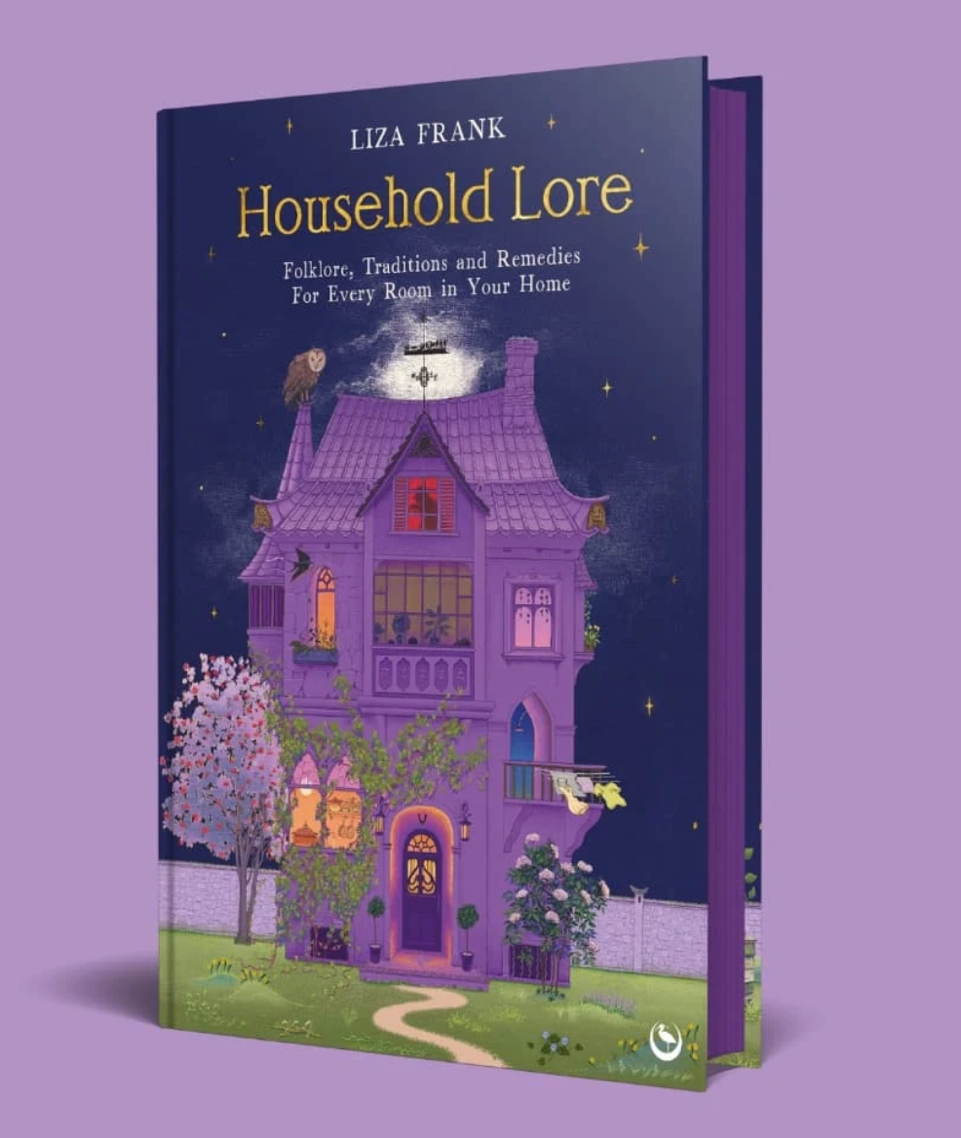
Household Lore ‘where every room tells a story and every dark corner holds a weird and wonderful secret’.
Household Lore is not your first book. In 2023, you published Everyday Folklore: an almanac for the ritual year, in which you invite readers to consciously participate in folkloric acts every day of the year. Why is it important for us to recognise the folklore we practice?
Folklore, at its heart, is the way we work. While it is quite possible to ignore the fabulous folkloric properties of a potato, it would be foolish to ignore what brings us together. For example, despite the dominance of the Gregorian calendar, not everyone celebrates the New Year at the beginning of January. However, New Year is almost always seen as a moment of reflection and new beginnings, regardless of geography or religion. Time and time again we see the tenacity of the human spirit reflected in rituals of hope such as love divinations, weather watching, wassailing, even crossing our fingers. We may all do it differently, but we are still all doing it. But mostly I feel it’s important because if we shut ourselves off from recognising ourselves in others, we create a dearth of empathy and that is a very dangerous path to start walking down.
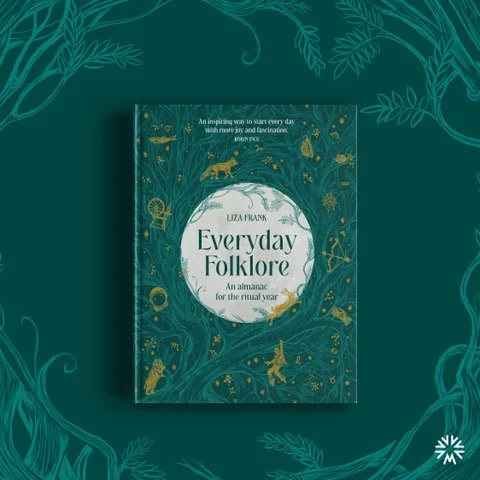
Household Lore: an almanac for the ritual year.
How did this book come about?
I thought it would be fun to live by, and experience, the rules of the ritual year every day for a whole year. I’d run other big creative projects before so The Everyday Lore Project felt very doable. Also, by this point, I’d been ghost-writing for several years, or writing for academia, or copywriting for work and I felt I’d lost my creative voice. Posting what I got up to every day on my website seemed like an easy way of recapturing that voice, plus it would keep me honest. So between St Distaff’s Day 2020 (7 January) and Twelfth Night 2021 (6 January), that’s what I did. It was tough because I thought I would be going up and down the country letting the folklore unfurl in front of me, but it ended up with all of us being locked down and me burning wicker men and baking heg peg dumps at home. It played to my Heath Robinson tendencies, but ultimately was quite exhausting. Very good research for the book that came after though!
And you also moonlight as The Folklore Agony Aunt. What has been your favourite problem you have been invited to fix?
I love all of them! It gives me another opportunity to look at the world in a different way and learn new things, most of them quite bonkers. One of my favourites, though, dealt with a boil on the bum. The one rabbit hole I regularly fall down is that of folk remedies. Just the hope and certainty contained in these little nuggets of wisdom is quite glorious. I have no idea why an old duck quacking three times into your mouth will help cure a boil, but at some point this remedy was recorded as part of a broader ritual. Just delightful.
You studied for an MA in Folklore Studies at the University of Hertfordshire. Would you advocate for the formal study of folklore and, if so, why?
Absolutely! I genuinely thought I knew what folklore was before the MA. It was mermaids! It was fairy tales! It was strange men dancing with antlers on their heads! And of course it is all that, but that’s just the beginning. It’s such a wonderful combination of social history, ethnography, anthropology, psychology, literature, neuroscience, and more. Folklore sits in the middle of everything, it’s integral for understanding how we work as humans. But more than that, the study of folklore teaches us crucial soft skills such as empathy, listening, how to engage, communicate and collaborate with others, and best of all, learning how to recognise the patterns and possibility in everything.
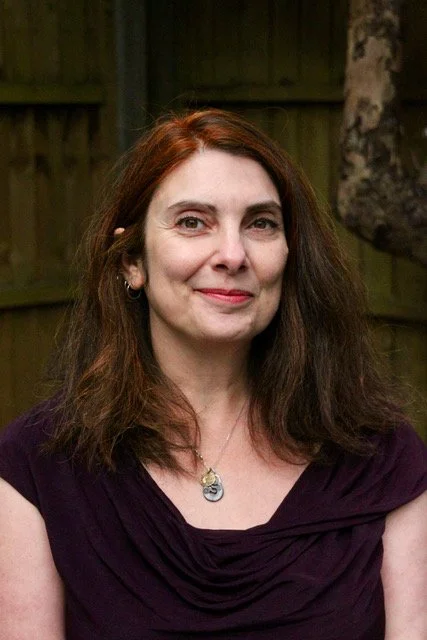
Liza Frank, image credit Sarah Fitzpatrick.
Do you have any folklore heroes? These heroes could be real, contemporary, historical, fictional…
Ceri Houlbrook and Owen Davies spring to mind! I’ll be forever grateful for their generosity of knowledge, the solid foundation they gave me during the MA in Folklore Studies and for their enthusiastic support since I graduated. But if we’re talking fictional, I’m a bit of a Baba Yaga fan. I mean, who wouldn’t want to live in a forest in a house built on chicken legs?
Do you have any other folkloric projects up your sleeve?
Yes, I have another book planned but I’m not going to jinx that by letting the cat out of the bag just yet. I’m also playing around with an idea for a short video project. If it materialises, you’ll be the first to know…
Liza Frank is a folklorist, writer and photographer. She has worked in theatre, running The Room Above The Pub in Richmond and working as assistant stage manager in various global locations with the Royal Shakespeare Company, among many other things. Following qualifications in photography, she published her photography project My Celebrity Boyfriend as a book with Bloomsbury in 2007, and has worked as a stills photographer for film and theatre. In 2021, she finished The Everyday Lore Project, a year-long challenge looking at ways to include folklore, superstition and tradition into her everyday life. Her second book, Everyday Folklore: An almanac for the ritual year, was published in 2023. Household Folklore: Folklore Traditions and Remedies for Every Room in Your Home was published by Watkins in November 2025. Liza also masquerades as The Folklore Agony Aunt, solving problems with the advice of the ages.