
The Green Man
Something a little different, this time. Member of the National Folklore Survey for England project team, Diane A. Rodgers, writes:
My late father, Andy Rodgers, a civil engineer at university and by trade, was a prolific amateur writer throughout his early retirement, enthusiastic about a wide variety of topics. As a folklorist, I was delighted to discover this piece that my dad wrote in the late 1990s about the roots and legend of The Green Man, pertinent (and our own logo!) as well as our latest release of findings about such figures from English folklore. We present to you the piece my dad wrote as our latest blog post: The Green Man by Andy Rodgers.
The Green Man
Buried somewhere deep in the human consciousness is an affinity with a half-mythical figure mysteriously known only as The Green Man. He is a figure of folklore, an enduring symbol and reminder of the closeness of man and woman to the earth and the natural environment.
The Green Man is an image from the depths of prehistory, signifying irrepressible life and symbolising life after death. He appears at various times throughout the history of art and culture in society, his origins going back thousands of years to well before Christian times, into the pagan roots of our culture. At various times he appears, then seems to die, then re-emerges after having been apparently forgotten for long periods. His roots can be traced back to imagery remaining from the remote times of around seven thousand years ago, from when many of today’s countryside customs are believed to derive. This same imagery recurs much later, in the third millennium before Christ, in the era of the building of Avebury and Stonehenge. He later appears in Roman art; in ancient Greece he is linked with the god Dionysos; and he is also associated strongly with the Celtic god Cernunnos. The Celtic races held a firm belief about immortality of the soul.
The Green Man manifests himself in visual form as a compelling image of a male head merging into (or emerging from?) leaves which mingle with and form his features. Sometimes he will be found disgorging vegetation from his mouth, emphasising the symbolic unity between humankind and the natural world, although, as this can also be interpreted as him devouring the vegetation, a different significance of this is referred to later. The pagan nature of his origins survives in folk customs, particularly such as the May Day festival in the Spring, and in woodcarvings and stone sculptures. In all his appearances he is an image of birth and renewal. The Green Man is thus linked to the spirit world and what lies behind death: he is the guardian and revealer of mysteries. That he survived the introduction and impact of Christianity is self-evident: his image appears on tombs in the early centuries after Christ, maintaining with his irrepressible vitality his association with death and subsequent re-birth.
In the Dark Ages, any resistance to technological innovation was much less than it was before the break-up of Roman rule, allowing the introduction of such things as the plough, the stirrup and the watermill. It is during this period of man’s assertion of his ‘mastery’ over Nature that The Green Man changes form from the older version ‘at one’ with the leaves, becoming the more sinister image of a devourer or disgorger of vegetation.
His appearances greatly increase in number in the 11th and 12th centuries, with the building of the great (and not-so-great) Gothic churches and cathedrals. Some cathedrals have so many carvings and sculptures of The Green Man (eg, Exeter, Southwell, and many in Europe, particularly Chartres) that we would be forgiven for thinking that the cathedral is dedicated to him rather than to God or to Christ. It has been said that The Green Man returned ‘in a damburst of imagery’. He had lain largely dormant for centuries while changes took place enabling his enduring significance to be recognised once more. The Green Man symbolised, to the great master masons of these monuments to Christianity, the gift of inspiration and renewal, hence the abundance of his appearances in their work. The Church, having ‘conquered’ the pagan past, and to help keep the balance, did allow the continuance of many formerly pagan practices such as the inclusion of these images in their buildings. They disturbed that balance, though, by attempting to crush popular ceremonies such as the May Day festival. Even a casual study of the nature of things teaches us that any entity will always tend towards its natural balance point - perhaps it is only now, hundreds of years later, that the balance is beginning to return.
Over the following centuries The Green Man was almost always present, appearing in the literary works of Shakespeare and Milton, putting in an eponymous appearance in the 14th century poem Sir Gawain and the Greene Knight (where the beheaded Greene Knight replaces his own head to live again), and culminating in many carvings in Sir Christopher Wren’s St Paul’s Cathedral. Not only is The Green Man a symbol of the prosperity of the time - he is also the very evidence of that prosperity, because carving, of his image and of others, was an expensive art.
At the end of that long emergent period, though, with changes in style and understanding he went back to sleep in the late 18th century. An image of balance between man and Nature was of little use to scientists of the emerging technology, or to mine and mill owners of the industrial areas. He did, though, re-awaken somewhat to make a relatively short-lived appearance in the late 19th century, although it’s not easy to say why. Cernunnos, The Green Man’s Celtic associate, was the god of wealth as well as of the underworld, so perhaps it was an unconscious representation of this link coming to the fore in the minds of architects and sculptors in the commercial spirit of that late Victorian era. However, as in earlier times, decoration was expensive, so it wasn’t long before The Green Man went to sleep yet again.
In his thousands of years of appearances, The Green Man is never given a name, apart from a sole carving in France which bears the word ‘Silvanus’. This was the name of the god of the countryside, and an Old English word for countryside is ‘greenmans’. The great number of public houses in England called The Green Man indicates the popularity and antiquity of the link. It is a particularly popular name in East Anglia, which is also the setting for Kingsley Amis’s novel, The Green Man, which also appeared in 1990 as a television adaptation.
The Green Man is predominantly a Sleeper, dreaming while he sleeps in preparation for his return, his dreams filtering into the consciousness of art. He seems to be quiet in the people’s awareness for long periods, re-emerging in difficult or stressful times. He began to re-appear in art during the Second World War. Now, at the turn of a new millennium, he is beginning to return again, possibly because there is an underlying feeling that we have been getting too far away from Nature and the environment, relying too much instead on machinery, electronic technology and so on.
It is perhaps no coincidence that the Green Man image is unknown in civilisations outside the Mediterranean basin and north-western Europe, which historically have been the main areas of technological/industrial/scientific achievement. Perhaps it is also no coincidence that there seems to be a link between The Green Man, Robin Hood (a champion of the people, who lived in the greenwood, and whose image appears on so many Green Man pub signs), the King of the May, and the Greene Knight. All are perhaps manifestations of the same image, having the similar attributes of regeneration, life after death, and representing the people against different forms of tyranny.
Man today has tended to lose direct contact with the soul; machines and the distant consequences of the physical revolution that began in the Dark Ages with the plough having separated him from Nature. The old ways of ‘Nature religion’ die hard, though - perhaps because they are becoming relevant to today’s search for meaning and the new reverence for Nature and the environment. As predictions abound of dangers through warming, pollution, stress and associated problems, we must pay attention to the re-emergence of The Green Man, a symbol of our attachment to Nature.
His is a compelling image, at once fearsome, formidable, strong of will and firm of purpose: an image of beauty symbolising one-ness with the natural world. He represents the concept that we come from the earth and return to the earth. He symbolises life after death. Like much of the greenery, he dies in the Winter yet is re-born in the Spring.
Our remote ancestors saw themselves as being of the Earth, whereas in modern times we have regarded Nature as being under our control. The Green Man has returned to remind us of our one-ness with the world. His current re-appearance in the world of art is, some believe, of profound significance.
Andy Rodgers
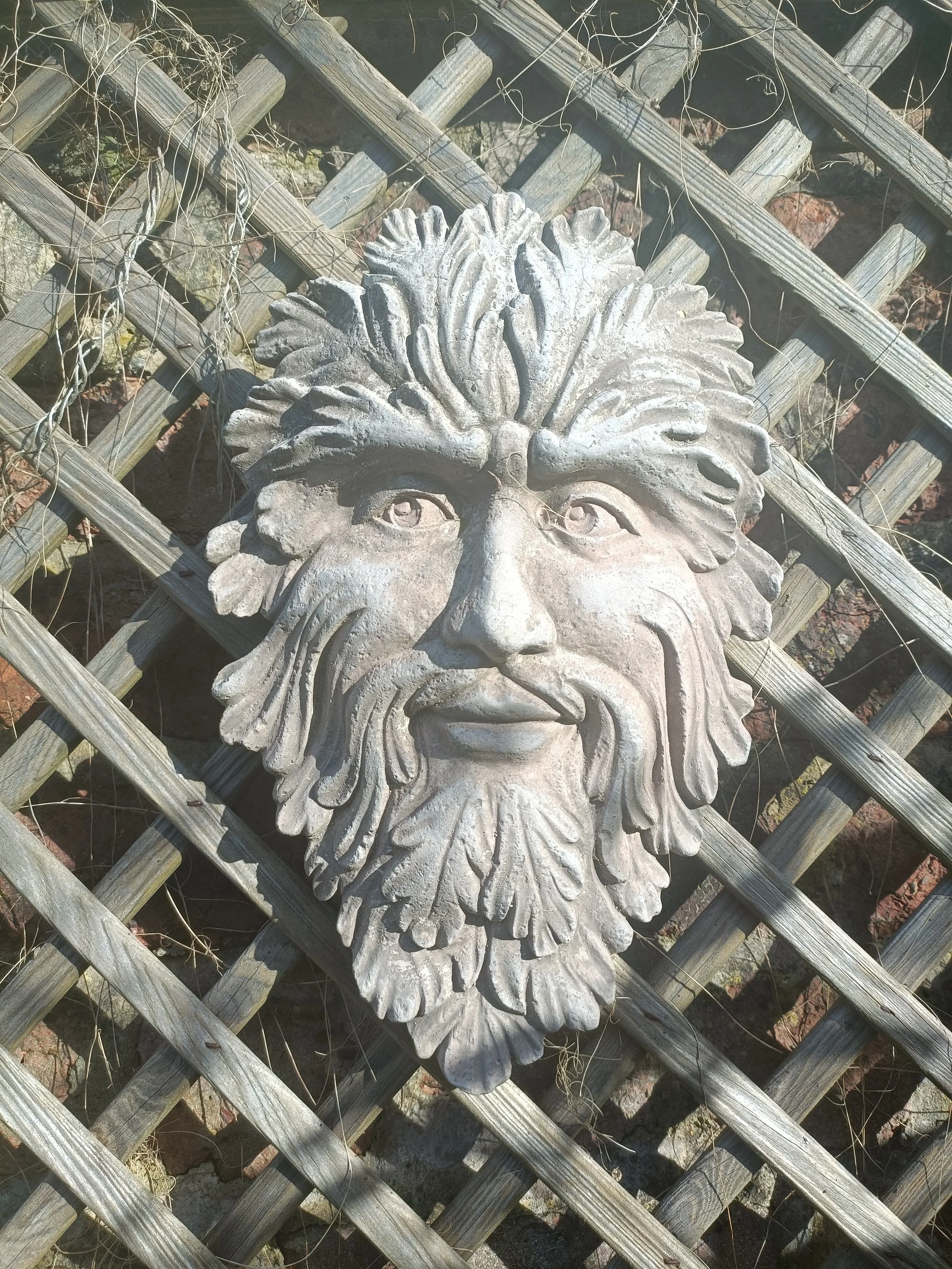
The Green Man, direct from Diane’s garden.