
Introducing… Josiah Eames
The Centre for Contemporary Legend (CCL) has a brand new PhD student, specialising in televised Christmas ghost stories. As it’s nearly Christmas, we thought we’d ask him for his Christmas viewing recommendations — and find out more about him, his research, and his interest in folklore while we’re at it.
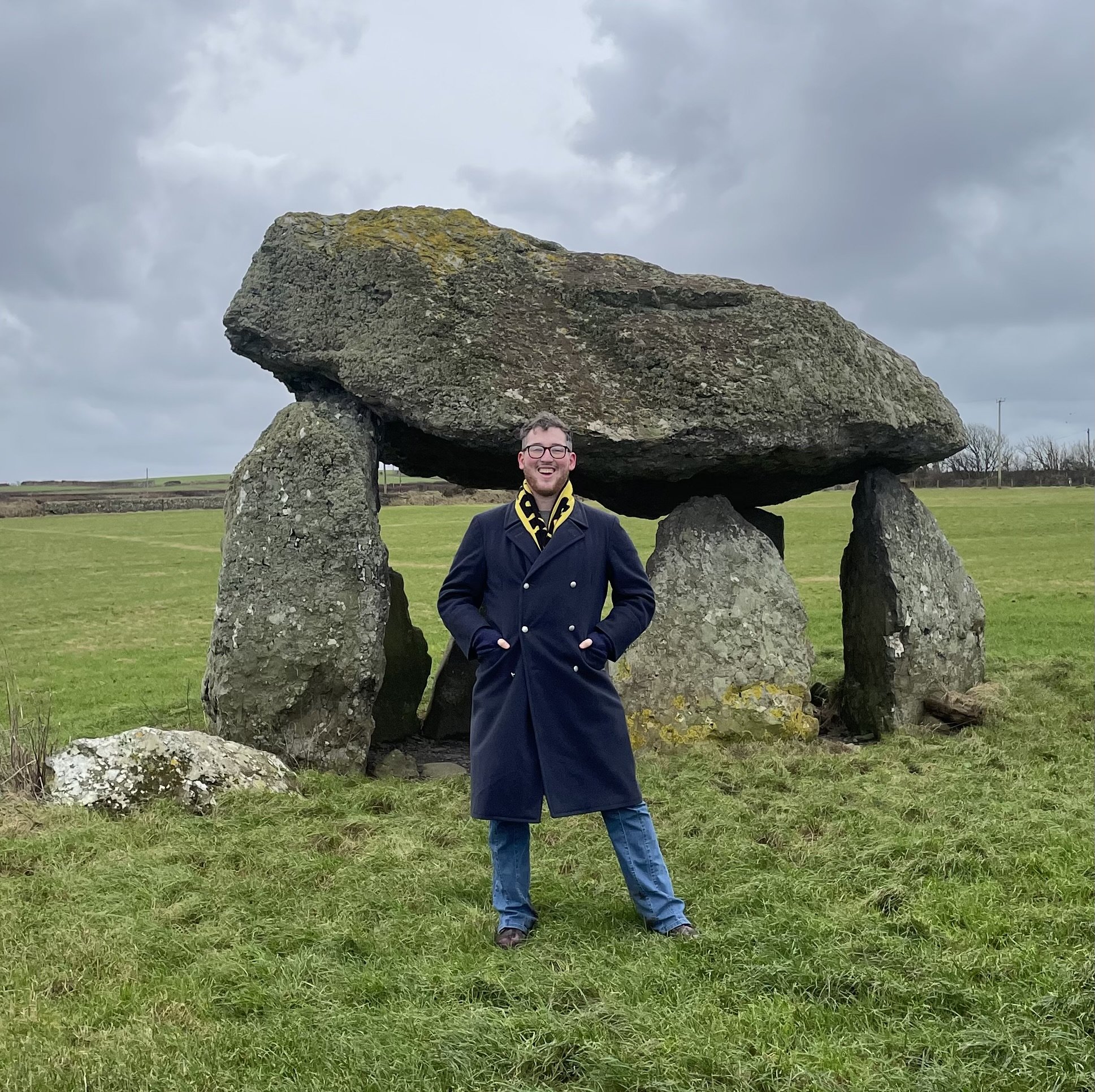
Josiah Eames, a lover of all things dark, gothic, and horror.
Welcome to the Centre for Contemporary Legend (CCL) at Sheffield Hallam University! It’s early days in your study, but can you tell us a little bit about what you hope to research during your PhD?
Hi! I’m so excited to be starting my PhD with the Centre for Contemporary Legend! My research is focused on the tradition of the Christmas ghost story in televised media since the year 2000. It’s a topic that has really captured my attention because it has such a rich history, ranging from literature in the canon of Arthurian legend to the works of famous authors such as Charles Dickens and Bram Stoker, as well as televised specials on the BBC; yet it seems to be almost entirely unrecognised as a tradition by the average person.
Most people that I have spoken to about my research in the lead up to starting my PhD have responded with something along the lines of ‘ghost stories at Christmas? Isn’t that more for Halloween?’ Of course, this isn’t the case for everyone – thanks to the findings of the National Folklore Survey, we now know that roughly 3.2 million people in England practice some form of engagement with Christmas ghost stories, however this is very much a minority of the population.
What I ultimately hope to research over the course of my PhD is how this tradition continues to exist in 21st century England, despite declining popularity, and to analyse the changes that have occurred in light of developments in society and modes of transmission. I can’t wait to see what I’ll uncover!
How did you come to this topic?
I have always loved ghost stories and the gothic; they’re an interest that has stuck with me all my life. As children, my older siblings and I would visit our great nana, she had a real talent for storytelling and would recount chilling tales of her experiences with the ‘Grey Lady’ of Wheatley Hall in Doncaster. My mum, having been told all the same stories growing up, always encouraged the interest and bought me books of ghostly encounters and haunted locations. She also introduced me to the Universal Monster and Hammer Horror films that she had loved as a child, which built upon an already present love of monsters, and sparked a voracious interest in all things gothic horror, as a teenager.
I discovered M.R. James during my second year of university, where I was studying film and television, through a collection of his ghost stories that I had picked up entirely by chance. I had near-exhausted the traditional canon of horror classics and was looking for something new. I burned through the collection and quickly learned that some of his stories had been adapted to television, as part of the BBC’s Ghost Stories for Christmas, which is where my interest in the topic began in earnest.
I dug deeper into the history of the Christmas ghost story and became fascinated by the concept of a forgotten Christmas tradition that, despite the popularity of Dickens’ A Christmas Carol and the continued production and airing of Christmas ghost stories on the BBC, had fallen almost entirely out of popular practice and recognition. I felt like a Jamesian protagonist delving through the past in search of knowledge. It helped that this newfound interest coincided with the discovery of folk horror, and subsequently the folklore that inspired it, so my mind was already primed for this sort of topic. When I left university, I decided that I wanted to get into academia, with the aspiration to research and teach. I learned about the Centre for Contemporary Legend and knew that this would the perfect opportunity to get stuck into researching the Christmas ghost story. Now, I’m nearly three months into my PhD and am absolutely loving it.
The National Folklore Survey for England revealed some intriguing findings about the tradition of reading or performing ghost stories at Christmas. It told us that 8% of respondents said that ghost stories were part of their Christmas traditions (roughly equates to 3.2 million people living in England). Of these, people were most likely to be in the 25-34 age bracket, with the next most likely in the 55-75 and 16-24 brackets respectively. The least likely age group to participate in ghost stories was the 45-54 age group. Is this what you expected?
Not at all; these results have really taken me by surprise. If you had asked me before, I would have predicted that the most popular age bracket would be 55-75, given that this generation would have been present for the original broadcast of the BBC Ghost Stories for Christmas in the 1970s, which has been the most popular iteration of the tradition on television. I would have also guessed that engagement would have declined as the age brackets became younger. However, the popularity of the tradition in the 25-34 age bracket is understandable as in the wake of the ‘folk horror revival’ in cinema, the publication of zines aimed at this age range such as Weird Walk (who are extremely active across social media), and the production of new television Christmas ghost stories under Mark Gatiss, the ability to engage with and learn about folklore and practices is accessible and promoted across mediums.
What are you looking forward to most during your studies?
There’s so much that I’m excited for, from the research itself to attending symposiums and conferences, but I have got to say that I am most looking forward to the time I will spend in the library throughout my research. I adore books, especially on folklore of course, and the John Widdowson Archive feels like an absolute treasure trove of wonder to me at the moment! Digging through books on myths and folklore feels akin to being a wizard in a fantasy novel as he delves into books of ancient, forgotten lore. I want to just spend months making my way through everything in there.
When did your interest in folklore begin?
Similarly to my love of ghost stories, my interest in folklore has been present all my life, though I don’t think I quite understood it as folklore for a long time. It is important to mention, first of all, that I have always indiscriminately loved monsters, from the Loch Ness Monster to vampires and everything in between. This probably springs from a combination of owning a copy of the Usborne Mysteries of The Unknown (which I read religiously), an obsessive collection of Monsters in My Pocket toys, and early exposure to films such as Clash of the Titans (1981) and The Mummy (1999). It was only a matter of time before I found all the delightful things that go bump in the night that folklore has to offer.
I have also always had a passion for history, particularly Ancient Greece and later the Viking Age and their mythologies. I found myself captivated by the beliefs of people from the past, which flowered to encompass reading about cultures from around the world: from Japan, Polynesia, pre-colonial America and countless more. I was fascinated by how these stories were used to make sense of the world, and how they differed depending on region, as well as environmental and social influences.
This all collided with my love of literary and cinematic horror, with the discovery of folk horror during university. Suddenly, my world was opened to a plethora of new folkloric influence, as I sought to track down stories that captured my imagination in the same way as folk horror cinema and television. Today my house is filled with collections of folk tales from around world, where they share shelf space with books on history, mythology, and horror fiction.
It’s two weeks until Christmas. What’s your ultimate Christmas viewing guide – film, television, past, present?
I have to recommend the BBC Ghost Stories for Christmas, which are mostly, adaptations of M.R. James’ short stories. Lawrence Gordon Clark’s work throughout the series in the 70s really captures the haunting atmosphere of James’ original tales, combined with that eerie feeling that is so prominent in television of the era. This series have recently been re-released by the BFI across two Blu-ray volumes, where they are accompanied by booklets of essays and viewing notes, making these editions the ultimate way to experience these Christmas spectres. If you only watch one episode this Christmas, I recommend A Warning to the Curious (1972). It’s a quiet, subtle, delightfully spooky tale of a man who fails to heed the warnings of the past, and is haunted for his transgressions, that encapsulates the best features of Christmas ghost story. Wait till about 10pm on Christmas Eve, put your phone away, turn the lights off, and let yourself be absorbed in its ghostly narrative.
Though it wasn’t released at Christmas, David Lowery’s The Green Knight, has been an essential part of my ‘wyrd’ Christmas viewing since it was released in 2021. The film is based on an Arthurian legend (the original poem is the earliest known example of a supernatural Christmas story) and sees a Christmas feast at the court of Camelot interrupted by the supernatural Green Knight, who challenges the young Sir Gawain to ‘a friendly Christmas game’. Lowery imbued the film with hauntingly beautiful cinematography and production design that gives the film an atmosphere that toes the line between fantasy and horror.
For a more mainstream recommendation, I have got to say Krampus (2015). This film, starring Toni Collette, gives the Hollywood treatment to the titular horned Christmas Devil whose roots lie in Alpine folklore. It was my first introduction to the concept of Christmas horror when I was fifteen and quickly became a firm favourite for its darkly comic moments and genuinely frightening creature design. It is a creepy, if cheesy, experience, best enjoyed with a Christmas drink, alongside family and friends who are willing to not take it too seriously.
Finally, the Christmas specials of Inside No. 9 make regular appearances in my Christmas schedule, particularly the series eight episode, The Bones of St Nicholas. This episode, released on December 22 2023, really harkens back to classic Christmas ghost stories from Charles Dickens to M.R. James, and mixes them in with the sense of dark humour expected from the series. The Devil of Christmas (2016) is another stand-out episode; it follows Krampus folklore and emulates 70s television (even going so far as to use vintage cameras) to create the right atmosphere. Both episodes have fantastic twists, surprises and laughs, making them perfect viewing for anyone looking for dark, yet festive, viewing.
Josiah Eames is in the first year of his PhD at the Centre for Contemporary Legend, Sheffield Hallam University, where he is researching the tradition of the Christmas ghost story in televised media since the year 2000. He lives in Doncaster where he is also a teaching assistant.