
It’s Christmas!
Do you have a Christmas tree to rock around? Do you roast your chestnuts on an open fire? Maybe you choose to hang your stocking on your wall, in the peculiar words of Slade?
Our latest tranche of findings from the National Folklore Survey for England reveals the top ten most popular Christmas traditions in 2025 – with a few surprises along the way…
First up, we are a nation of gift-givers and receivers: at Christmas, 66.6% of people living in England state they give and receive gifts – that’s over 27 million people. No wonder advertisers are so keen for us to part with our cash: gift-giving is a lucrative business.
Christmas food and drink is also very important to people living in England today. Having a Christmas meal is carried out by 63.5% of us, but we didn’t ask what constitutes that meal, so it could be the traditional turkey dinner with all the family – or a microwave meal for one. That it is designated a Christmas meal is interesting enough to us. Forty-one per cent of people living in England today intend to ‘eat and drink to excess’ – those supermarkets will be rubbing their hands again! – while making festive foods is high on the agenda, with 38% of respondents to the Survey claiming to do this.
Over half of the population*, at 58.3%, will be decorating a Christmas tree. But the result we found most surprising – and pleasing, we must confess – is that watching films and television at Christmas is as important a Christmas tradition as decorating the home and visiting friends and relatives (carried out by 57% of Survey respondents).
Dressing up for Christmas features more highly than hosting or attending a Christmas party (34.2% and 28% respectively).
The mums of England will no doubt cheer – or groan, depending on how much of the everlasting to-do list they’ve completed – as our Survey reveals that women engage in more Christmas traditions than men. Of our list of 19 Christmas traditions our Survey offered, women, on average, participated in 7.6 traditions, with men a paltry 5.4.
People living in London are most likely to say they have no Christmas traditions altogether, but Londoners are also more likely to attend a local or regional custom.
There were also some illuminating results when considering the religion and age of Survey respondents. It’s perhaps unsurprising that Christians are more likely to sing carols and attend a church service, but the Survey also found that Buddhists are most likely to decorate their home, go away on holiday at Christmas, and host or attend a party – but are least likely to visit or host family and friends. Jewish people are more likely to attend a local custom, while Muslims reported least likely to engage in any Christmas traditions. This is fascinating insight, and we’re busy trying to find out why certain religions engage with Christmas in different ways.
People aged 55-75* are a busy, Christmassy bunch, and are more likely to decorate a tree, have a Christmas meal, give gifts, watch Christmas television and films, and visit or host family and friends – but are least likely to take part in Secret Santa. Younger people, 16-24, are the most likely age group to participate in Secret Santa – but are also most likely to report not participating in any of the Christmas traditions the Survey offered. We wondered whether the Christmas traditions our Survey mentioned hold little truck with Gen Z, or whether older people have the time and money to go to town on Christmas traditions? This is certainly an area we’d like to research further.
Our Survey shows that encouraging belief in Santa Claus is widespread across England, but people aged 35-44 are most likely to do it, and those aged 25-34 least likely. It would be fascinating to know whether this signifies younger people taking an active stance in not encouraging a belief in Santa Claus, or whether there are fewer younger parents altogether. Another piece of research for the future!
We thought the readers of our website may be interested in the tradition of ghost stories at Christmas (the subject of an earlier post and the PhD topic of our new student, Josiah Eames). Eight per cent of Survey respondents – over three million people – said that ghost stories are part of their Christmas traditions, with people aged 25-34 most likely to engage. Interestingly, people without formal qualifications and Buddhists are most likely to read, listen to or watch ghost stories at Christmas.
Finally, another notable piece of data is that around one-fifth of respondents (approximately representative of 8 million people) stated that they had adopted a new Christmas tradition specifically because of something they had seen in film, television or online media. These traditions could be anything from wearing Christmas jumpers (which can be linked to the Bridget Jones or Nativity films) to baking particular foods (prominent in many American Hallmark Christmas films which are ever-present on many freeview channels and streaming services) to more obscure examples which we would love to know more about. Age was statistically significant, with new traditions most likely in the 25-34 age group, and region, with new traditions most likely to be adopted by respondents in London and the North West. In terms of religious background, respondents stating they had adopted new traditions were most likely to identify as Muslim (39%, as compared with 27% identifying as Christian, and ‘other’/no religion/Buddhist/Hindu/Jewish all between 13-16%).
*though please remember: under 16s and over 75s were not surveyed.
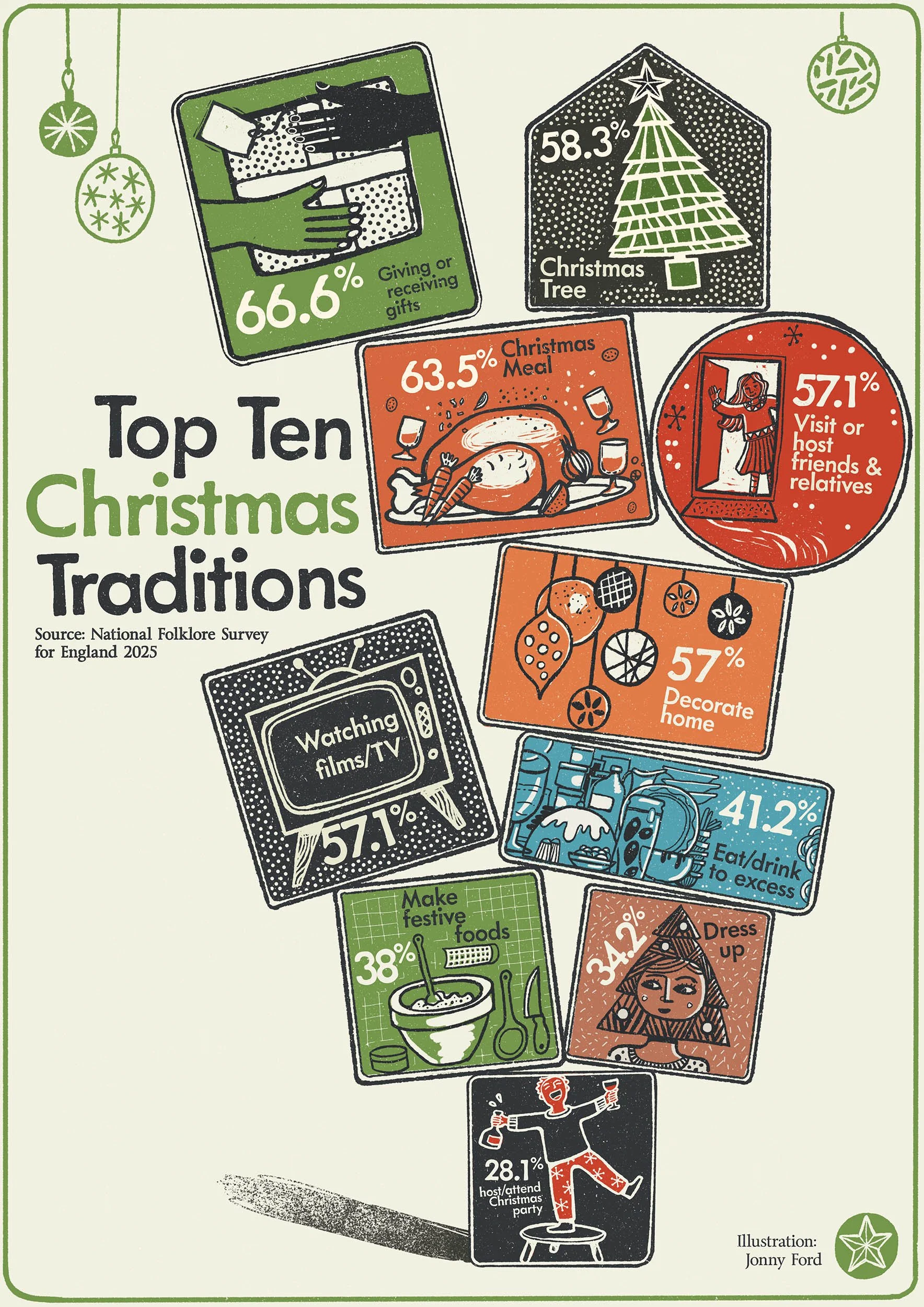
Beautiful illustrations from the inimitable Jonny Ford.