
The Centre for Contemporary Legend (CCL) has a brand new PhD student, who will be examining the role of the Green Man today. We thought we’d hand over to Poppy to hear more about her background and her research.
Welcome to the Centre for Contemporary Legend (CCL) at Sheffield Hallam University! We know you’ve only just begun (so no pressure!), but it would be lovely to hear more about your PhD and what you intend to research during your doctorate.
Thank you! I’ve already had such a great first few months with the Centre for Contemporary Legend. It’s been really exciting to meet other folklorists and see the breadth of work taking place in contemporary practice and research.
In terms of my own work, I'm looking into the Green Man and related eco-weird folklore, particularly in folk horror literature and on-screen. The Green Man has a tricky and slippery image which is part-human, part-vegetal. You might recognise him today as the great green wicker effigy which is ceremonially burnt at the Green Man music festival in Wales, or as an icon of environmental action groups, or even as a popular decorative ornament lurking amongst flower pots and ceramic gnomes in garden centres. For some, he is an image that survives from pre-Christian ritual, from ‘pagan’ worship of nature, and for others he is a familiar church grotesque embedded in Christian iconography. He is, in fact, all of these things and none of them, as no one actually knows the true origin of his image. We call him the 'Green Man' after Lady Raglan named him in 1939 by drawing together a disparate collection of medieval carvings, Victorian pageant customs and figures from British legend. In this sense, the Green Man is actually a relatively recent phenomenon.
What I'm trying to explore, then, is how the Green Man's popular resurgence, particularly in the genre of folk horror, intersects with the rise of Neopagan movements, and what the significance of his contrasting roles as a symbol of spiritual connection with nature and a figure of horror might be. Moreover, I’m interested in what his fairly modern history might tell us about how people articulate crisis-induced horror in the context of global warming.
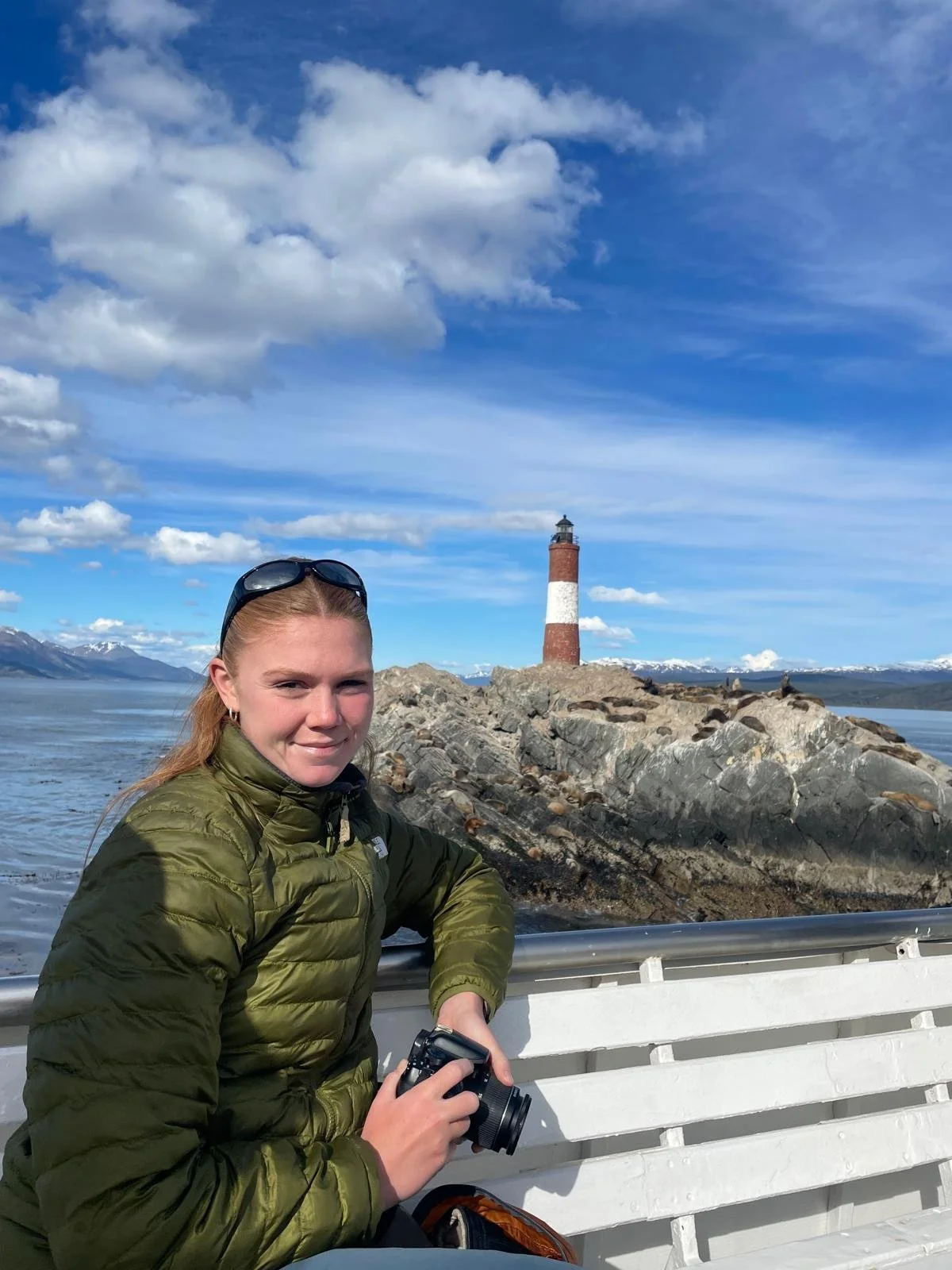
CCL’s new PhD student, Poppy Tollemache, is researching the role of the Green Man.
What's your background? How did you find yourself interested in this topic?
I was absolutely obsessed with the BBC serial adaptations of Robin Hood (2006) and Merlin (2008) as a child, both of which are full of magical and eerie woodland-dwelling things. They’re also some of the oldest stories of British folklore, and rooted in real places you can still visit today. For example, Robin Hood’s Sherwood Forest in Nottinghamshire, or the Dozymary Pool in Cornwall, where the Lady of the Lake emerged to hand King Arthur his legendary sword, Excalibur.
At university, I was introduced to medieval literature, which is totally infused with British folklore and legend, as well as the much darker side of fairy tale. I found myself especially drawn to texts featuring Green Man-adjacent beings, such as the Green Knight in Sir Gawain and the Green Knight, who is described ‘oueral enker-grene’ (‘entirely emerald green’) and in Sir Orfeo, when the king descends into a state of wildness after his wife's abduction by fairies, becoming interchangeable with ‘leves and gresse’ (‘leaves and grass’). More and more, I began noticing parallels between these medieval eco-weird figures and those in contemporary folk horror. That was when I started looking into the connection between the two.
When did your interest in folklore begin?
My dad was an English teacher, and my mum a writer, both lovers of stories and bird watching, so folklore was always around, especially if it made me and my brother pay more attention to nature. Folk music was also permanently on in the house, from Bob Dylan to Johnny Flynn, which has definitely influenced my own love of the genre. My parents were also interested in medieval folk traditions, and we would wassail most winters, a ritual involving singing to trees and pouring them libations of cider, accompanied by my mum playing folk tunes on her recorder. It was all very eccentric, and I wouldn’t have dared telling anyone at school (a large comprehensive in Hackney) about it, but now it’s a highlight of the Christmas period. Actually, there has been a huge surge in community wassailing groups, where people gather to bless trees in local parks and orchards. I’d definitely recommend giving it a go if you haven’t already, it’s a nice way to start the new year.
The National Folklore Survey for England asked people in England whether they had heard of the Green Man, and just over a third (36.3%) had, with 63.7% stating that they hadn't. And to give some context, 10% roughly equates to 4.1 million people. Does this surprise you at all?
This is fascinating, and yes, I'm surprised! I hadn't expected the figure to be quite so high. It's an exciting time to be researching contemporary Green Man folklore and I think, in part, we can put this down to the revived interest in folk customs and music that's currently happening in the UK.
Places like Hastings and Bristol have hugely popular folk festivals with dedicated Green Man (or Jack-in-the-Green) parades, where Morris dancers and folk bands accompany the processions of people painted green and adorned with foliage. I’ve already mentioned the Green Man music festival in Wales, which has become a major fixture in the British festival calendar.
Interestingly, the Green Man seems to be moving between different cultural spaces from Pagan and folk revival communities into mainstream music and popular culture. He's an image that people might recognise without necessarily knowing much about his history, or even identifying him by name. He was even used to decorate the coronation invite for King Charles III in 2023! This National Folklore Survey result makes me want to find out what different meanings people have for him.
What is it about your PhD that excites you most?
I've come into the world of folklore and media studies after an undergraduate and masters in English Literature, so I'm currently really enjoying getting to grips with the new disciplines. I’m also getting through lots of folk horror films, both the cult classics of the 1960s and 70s and more recent reworkings of the genre. My colleagues at the Centre for Contemporary Legend seem to have encyclopaedic knowledge of all things strange on-screen, so it's been brilliant to chat to them. I have an ever-growing film list!
Sheffield Hallam's John Widdowson Archive is an incredible collection of folklore material, and I'm keen to dig into some writing on the local 'Dark Peaks'. That's also been a brilliant part of moving to Sheffield, being so close to the Peak District.
What I'm most excited about, however, is figuring out how to translate my research into more public facing projects, and hopefully working with some really interesting heritage bodies to do so. I’ve recently found out I’ll be working with Hastings’ Jack-In-The-Green festival this spring, which will be an amazing opportunity to learn about contemporary engagement with the Green Man. Anyhow, that's a little further down the line, so lots and lots of reading for now. Great!
If you have any reading or viewing recommendations in which the Green Man appears, we'd love to hear them!
Absolutely. One of my favourite examples is in Max Porter's novel Lanny (2019), in the form of Dead Papa Toothwort, an ancient presence who observes the peculiarities of British life in a village on the outskirts of Bristol. Porter’s Green Man, however, is covered in ‘dregs of bitumen glistening thick with liquid globs of litter’ and ‘acid-rich mulch’, turning the spirit of the natural world into a horrifically rotting mass of human garbage, asking us to reflect on our relationship with the environment.
Excitingly, Lanny has recently been adapted for the stage by Bea Roberts, premiering at Bristol’s Old Vic in October 2026. I was lucky to catch its short run, and have heard rumours of a tour so I'd highly recommend seeing it if you get the chance.
Good luck with your research, Poppy! We’re looking forward to hearing more about it as it evolves.