
Introducing… Professor Owen Davies
In our Introducing… posts, we’ll tell you a little more about the team behind the National Folklore Survey for England.
You can learn more about Professor of Social History at the University of Hertfordshire, Owen Davies, in this latest post.
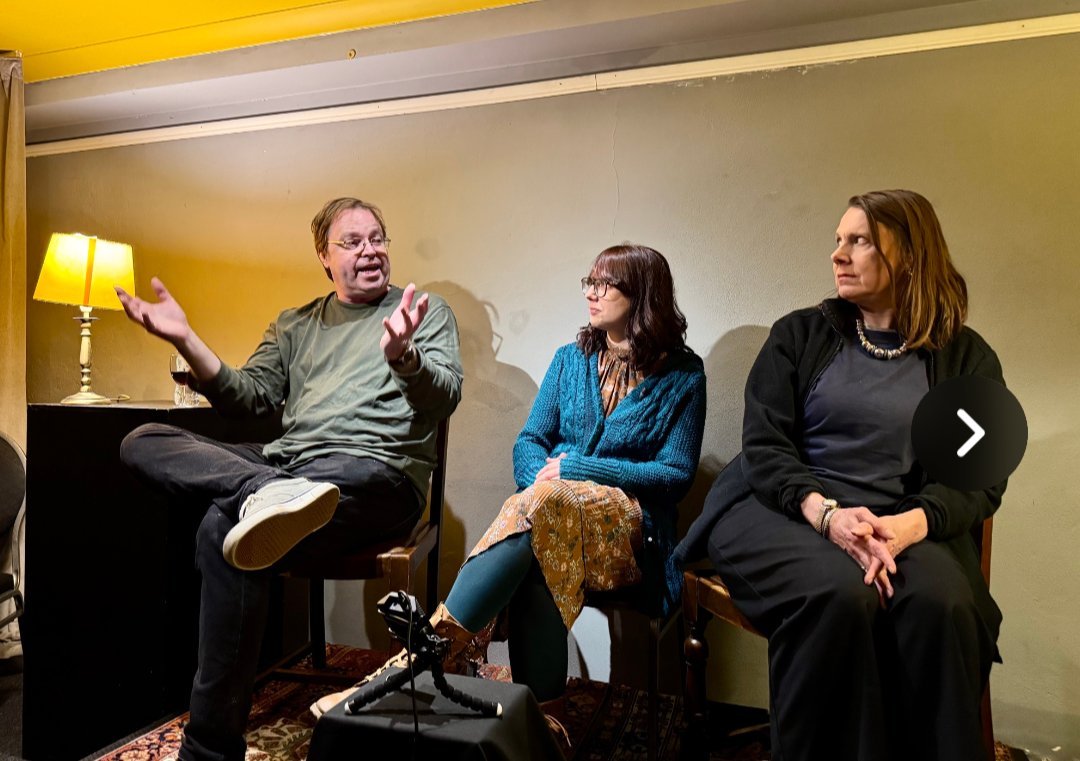
He doth protest too much… Professor Owen Davies (on the left), with Dr Ceri Houlbrook and Christina Oakley Harrington, the founder of Treadwells Bookshop.
You have been researching and writing about witchcraft and magic for decades. What is it that drew you to this subject?
A combination of influences and interests. I had a teenage interest in folklore and went on to do a degree in archaeology and history. Out of these interests I became fascinated with the material culture of magic and the popular belief in the supernatural. I read Keith Thomas’s classic Religion and the Decline of Magic (1971), and my immersion in folklore sources led me to question the thesis expressed in the book’s title. So, my PhD was about the continuation of the belief in witchcraft and magic from the eighteenth to the twentieth centuries in England and Wales. I wanted to show the fear and anxiety caused by witchcraft in popular culture and the important role of cunning-folk in society. This has led to further similar studies on France and America, and work on grimoires as a global phenomenon. Meanwhile Ronald Hutton was carrying out pioneering work on the origins of modern Wiccan witchcraft.
Folklore has a high profile in popular culture and consciousness at the moment, and witchcraft seems particularly appealing, especially for young people and across social media i.e. WitchTok. Why do you think this might be?
Social media provides instant communities of interest. Go back to the 1980s and earlier, and the different modern witchcraft communities communicated via moots, zines, newsletters, and letters. Then, at the same time as email and social media were really taking off, we had the rise of the American teen witch phenomenon inspired by the likes of Buffy the Vampire Slayer and Charmed. Social media allowed young people to connect across the globe to discuss what they seen and how they might emulate it. At this period, I used to get periodic emails from American high school students asking how they could learn more about witchcraft. This ‘Teen Witch’ phenomenon died down, and then new video forms of social media, first YouTube and then the likes of TikTok, gave a new means of expressing and sharing one’s conception of contemporary witchcraft and practice. It has been fascinating tracking this over the decades.
How was the study of folklore changed during the course of your career? Why were you keen to launch an MA in Folklore Studies at the University of Hertfordshire?
For historic reasons going back to the late nineteenth century, folklore studies never became a well-established academic discipline in Britain, as it would go on to do in the USA, Northern Europe, and elsewhere. Celtic Studies formed in Welsh and Scottish universities early on with a strong vein of folklore, and for some years the University of Sheffield ran a Masters programme. So, I was always aware that if I was ever going to introduce folklore as part of the curriculum it would be later in my career when I had more institutional influence. With Ceri Houlbrook and Leanne Calvert joining my History Department, I knew we had a sufficient body of relevant expertise to provide a coherent, research-led programme, and so try and re-stablish an academic foothold in English academia.
Congratulations on your recent publication, with Dr Ceri Houlbrook, Folklore: a journey through the past and present. Why did you feel now was the right time for a book of this scope?
Interest in folklore has been going through a major revival in Britain over the last few years, and there have been numerous books published, particularly those exploring calendar customs, legends, and traditions. This is all good to see, particularly as it is partly driven by a desire to connect with the country’s landscape and past. But Ceri and I wanted to critically reassess how we view this folkloric heritage, and also to show how folklore is just as much an expression of English, Welsh, and Scottish culture in the present. We recommended Bob Trubshaw’s helpful short book Explore Folklore to our students but wanted to write a book that was much wider in breadth and depth regarding the nature and interpretation of British folklore – a guide for how to understand critically as well as enjoy folklore.
Why were you keen to be involved in the National Folklore Survey for England project?
I was involved in the early discussions of the idea going back six or seven years, following a call for a survey by John Widdowson in an article in Folklore. Then David Clarke took the initiative for writing the application. Over the same period, Ceri Houlbrook and I had been running our MA in Folklore Studies at the University of Hertfordshire. Talking to our students each year further reinforced the need to capture what folklore means in England, at a time when English identity has become an increasingly challenging political and cultural issue. Capturing the multicultural nature of folklore through a survey provides a valuable baseline of data for future research in this respect.
Can you tell us about something you're working on now?
I am currently working on a new book with the provisional title Legend and Landscape: An Alternative History of Britain. It explores how place legends have formed and changed from the late medieval onward, and how ‘tradition’ often trumped factual historical interpretations of landscape features, sometime in problematic ways. It has been fascinating to explore the important role that antiquarians and fiction played in the creation of place legends over the centuries, and how seemingly old legends are often no more than a century old. It contains discussion on giants, the Danes, druids, religion, the supernatural, heroes and villains, lost towns and cities, landscape gardens, place names, and much more. It should be out in 2027. I also a have a new book out in 2026 entitled Divination: A Visual History.
Owen Davies is a Professor of Social History at the University of Hertfordshire. Much of his work concerns the belief in witchcraft, magic, ghosts, and popular medicine from the ancient world to the modern era. This has also led to work on global comparative studies, and interdisciplinary research applying archaeological, anthropological and biomedical knowledge to historical topics. Most recently, it has led to collaborative work on the reception of electricity in the homes of the poor. He also has interests in landscape history, heritage, and public history. His most recent book, co-authored with colleague Dr Ceri Houlbrook, is Folklore: A journey through the past and present.